
New York City’s Department of Social Services (DSS) is undergoing one of its most challenging eras in recent memory — and frontline workers say the pressure has reached a breaking point. As workloads surge and staffing levels shrink, employees across the system are being pushed into mandatory overtime, disrupting their personal lives and straining an already stretched workforce.
In conversations shared with NY Buzz, long-time civil servants described a growing crisis that has quietly escalated since the pandemic.
A Choir Practice Ruined — and a Career Routine Upended
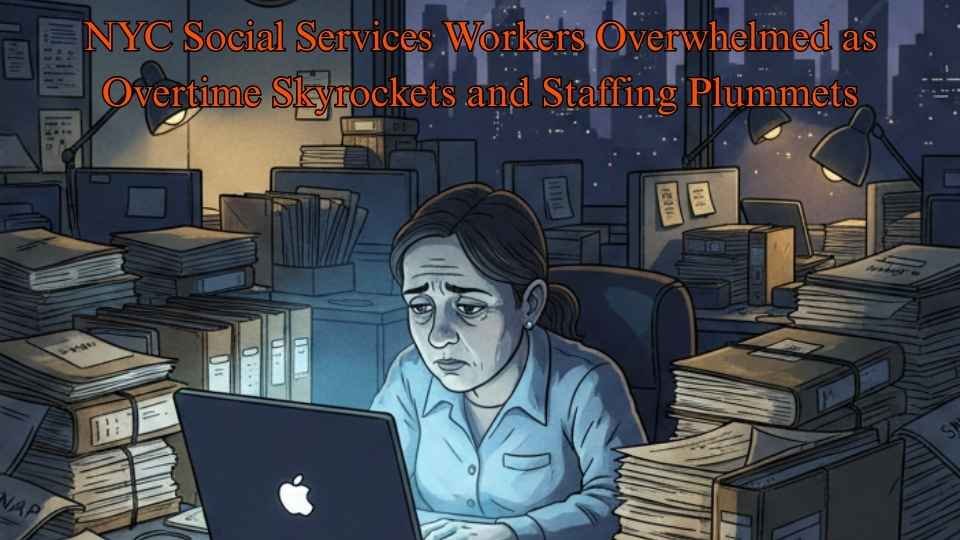
One social service worker, who spent 15 years in his role without ever needing to work late, now finds himself hauling his laptop to choir practice in the evenings. When mandatory overtime collided with his rehearsal schedule, he was eventually asked to leave the group entirely.
“I didn’t want to do overtime but they told us we had no choice,” he recounted, requesting anonymity to protect his job. For him, the shift wasn’t just an inconvenience — it was the collapse of a routine he had maintained for more than a decade.
Burnout Deepens in Brooklyn SNAP Office
At a Brooklyn SNAP processing unit, another veteran eligibility specialist described a similar pattern. During the pandemic, many experienced colleagues retired or resigned, leaving deep gaps that the city has yet to fill. With fewer hands to manage an ever-increasing number of applications, overtime has become a constant burden.
“The city needs to have enough staff to handle all these new cases,” she said. After 13 years with the agency, she has never seen the workload this overwhelming.
A Perfect Storm of Crises
DSS employees have become the frontline responders to a combination of sweeping challenges:
- A surge in benefit applications during and after the pandemic
- A rapid influx of asylum seekers
- Growing housing instability
- Rising poverty rates across the city
And now, another major responsibility looms: implementing the federal government’s new work requirements for the Supplemental Nutrition Assistance Program (SNAP). Staff must track compliance, verify supporting documents, and help recipients enroll in employment programs — a massive lift even in a fully staffed agency.
The Numbers Tell the Story: Fewer Workers, More Overtime
The Human Resources Administration (HRA), the branch of DSS that handles benefits, has seen overtime spending explode.
- In 2014, overtime cost the city under $22 million.
- In the latest fiscal year, it approached $75 million.
- In 2024, the cost hit a stunning $110 million, marking a historic peak.
At the same time, the workforce has shrunk. Nearly 12% of all DSS positions remain vacant. As of November, the agency — which is supposed to have nearly 11,000 employees — was short 1,439 workers, making it one of the most understaffed departments across city government.
The result? Those who remain are shouldering triple the workload their teams once managed.
A System at a Breaking Point
The combination of rising need and dwindling staffing has made mandatory overtime a way of life for many workers — even those who spent entire careers with stable schedules. For some, it has meant losing hobbies, community connections, and personal time they once relied on.
What’s happening at DSS mirrors broader national trends in the social safety net: fewer workers managing more crises with insufficient support.
City officials argue they are working to fill vacancies and ease the workload, but employees say the situation is already past the point of strain. If conditions don’t improve soon, the exodus of experienced staff could accelerate — further weakening the city’s ability to support vulnerable residents.
The Bottom Line
New York City’s social services system is feeling the squeeze from every direction. Rising overtime costs, shrinking staff numbers, and growing public need are reshaping the landscape of frontline social work. And with major federal policy changes on the horizon, the pressure shows no signs of easing.
For countless New Yorkers relying on SNAP, housing assistance, and other safety-net programs, the stakes could not be higher.